Don E. Gibbons, Ph.D., NJ Licensed Psychologist #03513
This Blog is published for information and educational purposes only. No warranty, expressed or implied, is furnished with respect to the material contained in this Blog. The reader is urged to consult with his/her physician or a duly licensed mental health professional with respect to the treatment of any medical or psychological condition.

Translate

Search This Blog

Saturday, July 15, 2017

Past Lives, Parallel Lives, and Future Lives: Believed-in Imaginings or A New Reality?

As an experimental psychologist who has been rigorously trained in the methods of scientific research, I frankly do not know whether or not reincarnation exists, though half the world believes in it. We tend to believe in things for emotional reasons, and then use our intellect to defend them  and neither do I know whether or not we can investigate these possibilities by the use of hypnosis.. Lynn and Kirsch (2006, p. 204), flatly state: "In summary, hypnotically induced past-life experiences are fantasies constructed from available clinical narratives about past lives and known or surmised facts regarding historical periods, as well as cues present in the hypnotic situation.”

It is just this kind of "anecdotal evidence," however, that is the starting point for any major revolution in our scientific view of reality. (Kuhn, 2012). Many of us know people who can tell of past-life experiences that are astonishing, to say the least; and some readers of this post may be able to recount such experiences themselves. If we are unable to completely dismiss all of this anecdotal evidence as merely delusional, perhaps we can look at the possibilities which this kind of evidence might imply

If there is a theoretically infinite number of parallel universes, it is also to be expected that they do not always follow the same laws of cause-and-effect as this one. Re-framing past, parallel, and future lives to conform with the teachings of theoretical physics regarding alternate and parallel universes greatly expands our understanding of what we can do with them. What we need to do at this point is not to abandon our investigation into past lives, but to to incorporate the possibility current, parallel, and future universes as well and see where it leads us.

1. If you are living in a parallel Universe which exists prior to your own life, we may have a rationale in theoretical physics for reincarnation

2. If you are living in a parallel Universe which exists after your own life, we may have a rationale in theoretical physics for pre-incarnation.

3. If you are living in a parallel Universe which exists in roughly the same time frame as your own life, we may have a rationale in theoretical physics for co-incarnation

4. If you are living in a parallel Universe in which you experience several different lives within a similar time frame, we may have a rationale in theoretical physics for multi-carnation.

5..If you are living in a parallel Universe in which you possess a set of genes which is partly yours and partly that of another person, we may have a scientific rationale in theoretical physics for inter-carnation..

References

Kuhn, T. S. (2012). The structure of scientific revolutions. Chicago, IL: University of Chicago Press.

Lynn, S. J., & Kirsch, I. (2006). Essentials of clinical hypnosis: An evidence-based approach.  Washington, D.C: American Psychological Association.

Saturday, July 1, 2017

How to Tell When Your Life is On The Right Track

How will we know, when our lives are on the right track? In the words of +Michael Ellner,
The path that the people who beat the odds take does not seem to be as important as the way they walk the path that they have chosen. This is based on extensive experience assisting people with life-threatening diseases and conditions and assisting people living with medically unexplained syndromes and symptoms like chronic pain, FMS, IBS and CFS. What they do — does not seem to be as important as how they do what they do… The people who do what they do with a happy heart, peaceful mind and playful spirit seem to have the best outcomes regardless of what they are doing.
  

Saturday, June 17, 2017

Mass Hysteria and the Power of Suggestion

I once was demonstrating hypnosis before an introductory psychology class, and I asked for volunteers to be hypnotized. Two students and their teacher, who was not much older than they were, volunteered, all of whom happened to be female. As I began the induction, the teacher began to giggle, and this set off the other two. 

When the giggling stopped and they had composed themselves, i began the induction once more. This time, the giggling was more intense when it broke out. I stopped, they composed themselves once more, and I began again. When the giggling broke out for the third time, it was so strong that the volunteers were rocking back and forth in their chairs,with laughter. I stopped the demonstration and the volunteers returned to their seats. 

I had seen people "get the giggles" before on rare occasions as I was hypnotizing them individually, and I had always stopped after one or two attempts to continue, believing that it was a form of unconscious resistance. This time, with three volunteers involved, it seemed to me that we were seeing a miniature version of mass hysteria -- a form of psychological contagion which the teacher had communicated to her two students who had volunteered along with her.

Hyperempiria, or suggestion-enhanced experience, isn't just an alert hypnotic induction, as some people still believe. It's any form of experience which is enhanced by suggestion, and which occurs outside of a formal hypnotic induction :-- even becoming a victim of mass hysteria, as depicted in the following trailer from the 2015 motion picture, "The Falling,"  (The full motion picture is available on You Tube; and the director, Carol Morley, has published an excellent article in The Guardian which describes several historidal instances of mass hysteria.)


Saturday, May 27, 2017

Shakespeare, the Dalai Lama, and the Serenity Prayer


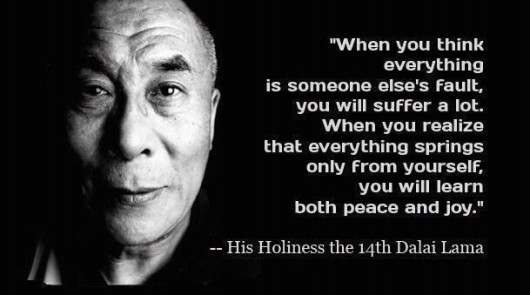
The traditional Eastern view of life may be summed up as follows:


The Western view, on the other hand, might be expressed in the words of Shakespeare:

To be or not to be, that is the question.
Whether 'tis nobler in the mind to bear the slings and arrows of an outrageous fortune,
Or to take up arms against a sea of troubles
And, by opposing, end them.

A modern version of this view is expressed in the following video:  


Who is right? If we were never willing "to take up arms against a sea of troubles," slavery would still exist, wives would always remain submissive to abusive husbands, and democracy would never have come into existence. On the other hand, for a small child growing up in an alcoholic and abusive home, a person toiling in dead-end jobs with no hope of getting another one, a prisoner serving a life sentence, or a patient in a hospice with a terminal illness, their only hope may be to turn inward in the quest for happiness and inner peace. 

For most of us, one answer may be appropriate in one situation or time in life, while the other answer may be appropriate at another time. I once had a Buddhist client with multiple  personalities, who told me that in Tibetan Buddhism you choose your parents according to what they can teach you. "I must have had to learn an awful lot," she told me. She sure did!  

A practical guide to making the appropriate choice is suggested in the following "Serenity Prayer" by theologian Reinhold Niebuhr, which has been adopted by Alcoholics Anonymous and other twelve-step organizations:

God, grant me the serenity to accept the things I cannot change,
The courage to change the things I can,
And wisdom to know the difference.


Monday, May 22, 2017

When You're Just too Depressed to DO Much


You're not suicidal. If you needed prescription medication, you're taking it.  But you just don't feel like DOING anything! And if you have a job or someplace else you need to be, you don't feel like going.  What can you do when your depression is serious enough to spoil your day, but not serious enough to seek prompt medical attention?

You obviously don't feel too depressed to be on the computer, but you could probably use some advice from people who know exactly how you feel. I would like to recommend that you begin with the Ted Talk on You Tube entitled, "How to Get Stuff Done When You're Depressed."  Then, while your depression is on the mend (and one thing that you can count on most of the time is that it will go away), you can help to cheer yourself up by watching four more videos from  their playlist on the subject of depressoon  They have dozens more, if you're still interested, both on the subject of depression and its treatment.

You might also be interested in:

How to Get a Good Night's Sleep 

How to Keep  Your Boss feom Driving You Crazy

Emergency First Aid for Panic Attacks

How to Meditate Like an Expert Almost Anywhere

Monday, May 1, 2017

Emergency First Aid for Panic Attacks

One of the worst things about having a panic attack is how frightened you are about having the next one. This will show you how help stop a panic attack while it is in progress. Please pass this information on to anyone who might be able to use it. You will be able to  prevent  a lot of needless suffering!   It is not intended to serve as a substitute for guidance from a duly licensed mental health professional, who can help you to understand and deal with the problems which brought about the panic attack in the first place.,  

Emergency First Aid for Panic Attacks

The best thing you can do during a flashback or panic attack is to ground yourself in the present. You can do this by using each of your five senses:

1. Look around you and name five things that you can see.

2.  Look around you and name four things that you can hear,

3,  Look around you and name three things that you can touch.

4.  Look around you and name two things that you can smell.

5.  Look around you and name one thing that you can taste.

This should gradually cause the panic attack to recede as you pay attention to the things in your environment and not to the memories that keep trying to flood into your awareness.

Confucius said, "The journey of a thousand miles begins with a single step." But once you have taken that step, you have to keep going. The two rules for success in any self-improvement program are: 1) Begin, and 2) Don't stop!  If you suffer from panic attacks, you should have plenty of motivation to follow both of these rules.

While methods of treatment may vary, It is generally agreed that the cognitive-behavioral approach is the fastest-growing orientation in psychology, with an ever-growing body of research behind it to demonstrate that it actually works. 

Cognitive-behavioral therapists frequently use a document called a panic attack thought record in order to help you get rid of the wrong ideas and perceptions which may be contributing to your anxiety, and to alter the situations which trigger them. A summary of The "STOPP" technique, which has been referred to as "CBT in a nutshell," is available. There is also a free online self-help course and other materials on how to use them. You can make as many copies of the forms and other information as you want for your own use by using the print command on your computer. (Much of the foregoing information is available courtesy of www.getselfhelp.co.uk.)

Once you get the hang of it, if you continue to do these mental workouts as regularly as you would exercise physically in a gymnasium, you will eventually become able to think, feel, and act in a calm and confident manner in almost any situation. However, just as reading a book on surgery will not make you into a surgeon, and reading an exercise manual will not build muscles, merely reading a Blog posting on how to avoid having panic attacks will not be enough to enable you to teach you how to get rid of them. People who practice meditation, for example, do not hope to attain enlightenment merely by reading about it! By the same token, regular practice using the thought record for a variety of situations is the key to success. 
   
How to Identify a Panic Attack

How can you be sure that what you are concerned about is a panic attack and not something else? While an actual diagnosis should only be made by a duly-licensed mental halth professional, it may be helpful to knlow that the Diagnostic and Statistical Manual of the American Psychitric Association (2013, p, 208) defines a panic attack as an abrupt surge of intense fear or intense discomfort that reaches a peak within minutes, and during which time four (or more) of the following symptoms occur:
  1. Palpitations, pounding heart, or accelerated heart rate.
  2. Sweating.
  3. Trembling or shaking.
  4. Sensatons of shortness of breath or smothering.
  5. Feelings of choking.
  6. Chest pain or discomfort.
  7. Nausea or abdominal distress.
  8. Feeling dizzy, unsteady, light-headed, or faint.
  9. Chills or heat sensations.
  10. Paresthesias (numbness or tingling sensations).
  11. Derealization (feelings of unreality) or depersonalization (being detached from oneself).
  12. Fear of losing control or "going crazy."
  13. Fear of dying.
For at least a month after the panic attack, either or both of the following must take place: a) the person is extremely worried that either the panic attack itself, or what he or she was so afraid of while the panic attack was going on (losing control or going crazy), is going to happen again; and/or b) the person makes a "significant, maladaptive change in behavior"  in order to keep the panic attack from recurring, "such as avoiding exercise or unfamiliar situations." 

To meet the definition of a panic attack, the symptoms cannot result from a drug reaction, nor can they be a symptom of something else such as schizophrenia.x

Reference

American Psychiatric Association: Diagnostic and Statistical Manual of Mental Disorders, Fifth Edition, Arlingron, VA, American Psychiatric Association, 2013.

Sunday, April 23, 2017

How to Get Around to Overcoming Procrastination

The following link was posted by Bill Kennedy on the discussion forum, Hypnothoughts.com. It's a very cleverly-written piece that does not require the use of hypnosis to be effective. Bill correctly points out that not everyone's experience of procrastination will be identical, and so this strategy may not work for anyone He also points out that one should not characterize the monkey in the imagery as "bad." The goal, as Bill says, is to get the monkey playing in the "Happy Playgro
und rather than in the Dark Playground."

http://waitbutwhy.com/2013/11/how-to-beat-procrastination.html

On the same forum, Barry Neale pointed out that "procrastination can often be a symptom of depression; but even if it is, the following YouTube presentation may often help https://www.youtube.com/watch?v=1FJ5dkizJTs 

Finally, the following WikiHow article provides an excellent summary of how to pick up the pace when discouraging thoughts are getting in the way.  You can also concentrate more effectively on your autosuggestions by preparing the mind with various forms of meditation or self-hypnosis; but the most important thing is the thoughts themselves.

How to Overcome Procrastination Using Self Talk

from wikiHow - The How to Manual That You Can Edit

We talk to ourselves all the time in our minds. Even when we're not paying attention, these relentless mental debates deeply influence our feelings and, ultimately, our behaviours and actions The good news is that if you can become aware of these mental dialogues, notice the patterns, and turn them into productive statements, then you are empowered to overcome many unwelcome feelings and behaviors. Let’s see how this can help us when it comes to procrastination.

Steps

  1. Recognize the procrastinator's motto. Consider the following thought, which surely crosses our minds many times in one form or another:“I have to finish this important task. It should already be done by now and I just need to do it.”This small, seemingly innocent thought contains almost every mental block that encourages procrastination. We all use the Procrastinator’s Motto (or variations of it) every once in a while. If you’re a chronic procrastinator, chances are you repeat it to yourself very frequently — daily, perhaps.But what’s so wrong about the Procrastinator’s Motto? In what ways do these words encourage procrastination so much — and what can we do about it? Let’s consider each part of this statement in turn, replacing each of them with an empowering alternative. In doing that, we’ll turn the original motto on its head and create a productive call to action: a “Producer’s Motto”, if you like.
  2. Remember that you don't 'have to' do anything. ‘I have to’ is every procrastinator’s favorite expression. It’s also the most disempowering. Every time you say to yourself that you have to do something, you imply that you don’t have any choice, that you feel forced or coerced to do the task — that you don’t really want to do it. That perception, of course, elicits a strong feeling of being victimized and resistance toward doing the task. The solution to this problem is to replace ‘I have to’ with the immensely more empowering alternative ‘I choose to’ or 'I will'. Everything you do is ultimately a choice (yes, even completing tax forms). Using language that expresses choice reminds you of that and brings the feeling of power back.
  3. Focus on starting, rather than finishing. When you focus on finishing something, you direct your attention to a vague, highly idealized future. Visualizing a finished project is motivating for many people, but for someone who’s having a hard time starting a task, visualizing a hard-to-grasp future can be overwhelming — even depressing. The solution in this case, then, is not to focus on finishing, but on starting. Forget for a minute about the finish line, just concentrate on giving your first step. Bring your focus from the future to what can be done right now. We all know that if we start something enough times, we'll eventually finish the task. Starting — all by itself — is usually sufficient to build enough momentum to keep the ball rolling.[1]
  4. Break a long project down into short tasks. Dwelling on the size and difficulty of a looming task will overwhelm us, and thus promote procrastination. Any undertaking, no matter how daunting, can be broken down into smaller steps. The trick is — with each step along the way — to focus solely on the next, achievable chunk of work. Ignore the big picture for a while and just tackle that next small task. Make sure you can easily visualize the outcome of your small task. Don’t write a book; write a page. If it is still intimidating, commit yourself to work on it for a specific period of time.Keep the big picture in mind, of course, but don't allow it to frighten you. Use it for motivation and direction.
  5. Don't place too much pressure on yourself. “This project has to impress everyone; I really can’t blow this opportunity.” Placing such high hopes on a project only adds anxiety and fear of failure. Perfectionism fuels procrastination. Overcome this mental block by simply giving yourself permission to be human. Allow yourself to be imperfect with the next small task. You can always refine your work later. If you’re a serial perfectionist, go one step further and commit yourself to doing a sloppy job on purpose — at least at first. Instead of making every step perfect, think of them as steps toward perfection. For instance, write a page or two now, then proofread and correct them later.
  6. Stop thinking about the way things 'should' be. The expression 'should' invokes blame and guilt. When you say you should be doing something (instead of what you’re actually doing), you focus on comparing an ideal reality with your current, “bad” reality. You focus not on what is, but on what could have been. Misused 'shoulds' can elicit feelings of failure, depression and regret. The solution is not to focus on how you feel now, but on how good you will feel after you begin to take action.
  7. Take some directed action. Even the tiniest progress is success — moving toward a goal is the best motivator. The trick is to bring that expected feeling of accomplishment into the present — and know that the real joy of progress is only a small task away. That small step is success.Success is not the end of your task. Success is the progress that leads you to your next step.
  8. Make it fun! “I’ve got to work all weekend”. “I am trapped in this laborious project”. Long periods of isolation can bring an enormous feeling of resentment. These feelings generate a strong sense of deprivation and resistance toward the task.Overcome this mental block by avoiding long stretches of work. Schedule frequent and brief breaks. Plan small rewards along the way. One idea is to work near a break area. Have something to look forward to — not far away and not at the end of a long stretch — but in the very near future. When rewards are small, frequent, and deserved, they work wonders. Truly commit to brief bursts of relaxation and leisure time. In fact, go ahead and make it mandatory. This “reverse-psychology” can, by itself, give you a more productive and enjoyable mindset.
  9. Rephrase your internal dialog. Time to check what we’ve accomplished with all the word substitutions. We started with:“I have to finish this important task. It should already be done by now and I just need to do it.”And ended up with:“I choose to start this task with a small, imperfect step. I’ll feel terrific and have plenty of time for fun!” Quite a change, eh? Every time you catch yourself repeating any part of Procrastinator’s Motto to yourself, stop and rephrase it. Then check how you feel. At first, it may seem to be a simple matter of word choices. But when you try this simple way of reframing your thoughts, you’ll see how it instantly changes your attitude toward your tasks. Moreover, if you turn it into a habit, you’ll slowly reprogram your thoughts, and make a positive, permanent change in your mindset.
Tips
  • You can also provide yourself with an extra measure of motivation by using the Best Me Technique of self-hypnosis to pre-experience the rewards of a long-term goal, thereby reducing or eliminating the need for "will power."
  • Some other "procrastinator phrases" include:[2]
    • "I just don't really feel like doing this right now. I will do it later." And say "If it can be done tomorrow, it can be done today."
      • Say instead: “Even if I can’t get the whole thing done right now, I can start on this part.”
    • "It's no big deal if it doesn't get done."
      • Say instead: “This is important to ME, so I choose to start now.”
    • "It won't take me that long."
      • Say instead: “This may take a long time, but I choose to start now and get part of this done right away.”
    • "It's not fair."
      • Say instead: “I choose to do this.”
  • Taking on a second-person view can also help. Tell yourself: "You know you’re just putting this off. Take the time right now and get started on this part. You’ll feel better and then you can take a break, or start on another small part."[3] 
  1.  This is what Mark Forster calls the “I’ll just get the file out” technique.
  2.  http://livingwelltools.com/procrastination.htm
  3.  http://www.catalystorganizing.com/articles/Later_Never_Comes.pdf
Article provided by wikiHow, a wiki how-to manual. All content on wikiHow can be shared under a Creative Commons license.


Sunday, February 5, 2017

Viirtual Reality Hypnosis? Throw Away Those Goggles!

Most people are familiar with Charles Dickens' story, "A Christmas Carol," in which the miserly Scrooge is sited by three spirits who "scare the Dickens" out of him and he becomes a lovable old gentleman who "knew how to keep Christmas better than anyone."If Dickens had been writing in the twenty-first century instead of the nineteenth, he would probably have had Scrooge make a few visits to an experiential hypnotist who, as Kelley Woods and I have been doing, would use hypnosis guide the client to a series of parallel universes, in which things would turn out differently i-- except we know now that we should use love and happiness rather than fear as an incentive to make the point. We don't need to use 3-D glasses to use virtual reality hypnosis. We use a combination of Kelley's mindful hypnosis and Don's BEST ME technique to allow clients to project their entire being into another Universe -- and it works!

Virtual Reality Hypnosis: Adventures in the Multiverse extends Dickens' approach to the modern era, often with dramatic results., Clients have been saying things like, "I can't thank you enough!" and, "I'm at a point in my life now where I think I can accomplish anything!" The changes which they are reporting in their lives seem to bear this out.

Sunday, August 21, 2016

How to Use Meditation to Identify Life Goals -- and Deal with Stress Along the Way

There are four basic stages of problem solving:


  • Preparation, in which you become familiar with the elements of a problm by turning it over in your mind;
  • Incubation, or letting it "sit" for a while as your right brain or "unconscious mind" works to come up with a solution; 
  • Illumination, or a sudden insight which presents itself as a solution; and 
  • Verification, or actually checking the solution to see if it is really going to work.ted  

  • Meditation is an excellent way of stoking your mental processes to speed up the incubation stage when you are seeking a solution to a problem or a life goal which has been which has been eluding you.  Although the process may still take some time, meditation is also an excellent way of dealing with the strong emotions which may arise while you are awaiting a solution and, eventually, while you are pursuing it. The following WikiHow article on meditation has been by edited by nearly 700 people and read by over 1-3/4 million. In addition to its other uses, I heartily recommend it as a means of identifying aims and purposes which then can be formulated into 
    winning goals.

    How to Meditate

    from wikiHow - The How to Manual That You Can Edit

    Meditation is a mental discipline by which one attempts to get beyond the conditioned, "thinking" mind into a deeper state of self awareness. To free one's awareness from associating solely with the mind and its soul. There are many different meditation methods. At the core of meditation is the goal to focus and eventually quiet your mind, thus freeing your awareness. As you progress, you will find that you can meditate anywhere and at any time, accessing an inner calm no matter what's going on around you. You will also find that you can better control your reactions to things as you become increasingly aware of your thoughts (letting go of anger, for example). But first, you have to learn to tame your mind and control your breathing.

    Steps

    1. Make time to meditate. Set aside enough time in your daily routine for meditating; early morning and in the evening are often most preferable. The steadiness of mind meditation is most noticeable when you do it regularly; some people like to end the day by clearing their mind, and some prefer to find refuge in meditation in the middle of a busy day. The easiest time to meditate is in the morning, before the day tires your body out and gives your mind more to think about. Just take care to avoid spending too long meditating––start with around 5 to 15 minutes a day.
    2. Find or create a quiet, relaxing environment. For the beginner, it's especially important to avoid any obstacles to attention. Turn off TV sets, the phone or other noisy appliances. If you play music, choose calm, repetitive and gentle tunes, so as not to break your concentration.
      • Meditating outside works for many meditators. As long as you don't sit near a busy roadway or another source of loud noise, you can find peace under a tree or sitting upon some lush grass in a favorite corner of the garden.
    3. Sit on level ground. Sit on a cushion if the ground is uncomfortable. You don't have to twist your limbs into the half lotus or full lotus position or adopt any unusual postures. The important thing is to keep your back straight, as this will help with breathing later on.
      • Tilt your pelvis forward by sitting on the forward edge of a thick cushion, or on a chair that has its back legs lifted off the ground 8 to 10 cm (3 or 4 inches).
      • Starting from your bottom, stack up the vertebrae in your spine, so that they are balanced one on top of another and support the whole weight of your torso, neck, and head. Done correctly, it feels as if no effort is required to hold your torso up. (A small amount of effort is in fact required, but with the right posture, it is so small and evenly distributed you don't notice it.)
      • Relax your arms and legs. They don't need to be in any special position, just as long as they are relaxed and don't interfere with balancing your torso. You can put your hands on your thighs, but it might be easier at first to let your arms hang at your sides––the hanging weight helps reveal where things are out of alignment.
    4. Relax everything. Keep searching for parts of your body that aren't relaxed. When you find them, (and you will), consciously relax them. You may find that you can't relax them unless you adjust your posture so that you are better aligned, and that place doesn't need to work anymore. This commonly happens with muscles near your spine. You may also notice that you are twisted a little and need to straighten out. Little muscles in your face often keep getting tense, too.
    5. Let your attention rest on the flow of your breath. Listen to it, follow it, but make no judgments on it (such as "It sounds a little raspy... maybe I'm getting a cold?"). The goal is to allow the "chattering" in your mind to gradually fade away. Find an "anchor" to settle your mind.
      • Try reciting a mantra (repetition of a sacred word). A single word like "om" uttered at a steady rhythm is best. You can recite it verbally or just with the voice in your mind. Beginners may find it easier to count their breaths. Try counting your breath from 1 through 10, then simply start again at 1.
      • To circumvent images that keep intruding on your thoughts, visualize a place that calms you. It can be real or imaginary. Imagine you are at the top of a staircase leading to a peaceful place. Count your way down the steps until you are peaceful and relaxed.
    6. Silence your mind. Once you've trained your mind to focus on just one thing at a time, the next step is focus on nothing at all, essentially "clearing" your mind. This requires tremendous discipline but it is the pinnacle of meditation. After focusing on a single point as described in the previous step, you can either cast it away, or observe it impartially and let it come and then go, without labeling it as "good" or "bad". Take the same approach to any thoughts which return to your mind until silence perseveres.
    Tips
    • It is easy to lose track of time while meditating. Being concerned about time can be distracting to meditation. Some people find it liberating to set a timer and let it be concerned about how long you have to meditate. Choose a gentle timer. If it is too jarring, the anticipation of the alarm can be distracting.
    • Some other benefits that are less observable for most people include: falling asleep more easily, more ease in fighting addictions, altered states of mind (which are most prominent in people who have spent over 10,000 hours meditating such as Buddhist monks), and most recently discovered is that meditation on the concepts of calmness and relaxation can turn off genes within every cell in the body that cause cells to become inflamed when you are under a lot of stress.
    • If you find it difficult to meditate for the length of time you have chosen, try a shorter time for a while. Almost anyone can meditate for a minute or two without experiencing intrusive thoughts. Then, as the ocean of the mind calms, you gradually lengthen your meditation session until you have achieved the desired length of time.
    • With good posture, it will be easier to breathe as your lungs will have more space. In fact, you may notice how most of the muscles in your torso work to help you breathe, from the muscles in the base of your pelvis to the ones in your neck, centered on the main breathing muscle, the diaphragm. They work just a little, assisting the diaphragm. If you notice this, it's a good sign you have established a good posture. The right posture is easy and comfortable. You almost feel like you are floating.
    • You should be comfortable enough to concentrate, but not so comfortable that you feel the urge to fall asleep.
    • Set aside a specific time each day for meditation, but don't overdo it. If 20-30 minutes in the morning isn't enough, add another session later in the day instead of trying for a single, longer session.
    • Make some effort to be mindful of your mood and thoughts when not meditating. You may notice that you feel calmer, happier, and sharper on days when you have meditated, and notice a decrease in these qualities when you have not.
    • Meditation practiced over a long term period of time have been shown to have many beneficial results and is well worth continued practice. Benefits include: Increased mindfulness and awareness, reduced stress, calmer and more relaxed moods, improved memory and focus, and increased in grey matter (brain cells) in various parts of the brain.
    • It may be beneficial to mentally review or replay the previous day at the start of your sessions, if you can do so in a relaxed, passive way. This often happens naturally, and sometimes it's best to allow this to happen, as long as you don't get emotionally wrapped up or let it go on too long before beginning meditation. This procedure is known as "processing" of recent events, and becoming skilled at performing a non-judgmental review of events does much to increase awareness and emotional well-being.
    • Do what works best for you. What works for some people might have other techniques that might not work for you. Don't let that get you down. Remember to relax!
    • The benefits of meditation can be experienced long before the practitioner has been successful in maintaining focus or clearing the mind, simply as a result of the practice.
    • What you do with a silent mind is up to you. Some people find that it is a good time to introduce an intention or a desired outcome to the subconscious mind. Others prefer to "rest" in the rare silence that meditation offers. For religious people, meditation is often used to connect with their God(s) and receive visions.
    • For some people, focusing attention on a point or object does exactly the opposite of what meditation is all about. It takes you back to the life of focus, concentration, strain. In this case, as an alternative to the above techniques, some meditators recommend un-focusing your attention. Instead of focusing attention on a point or an object, this type of meditation is achieved by attaining a state of zero. Take your attention above all thoughts to a point where you lose all attention and all thoughts.
    • Do not force yourself to meditate. You should want to meditate before think about trying.
    Warnings
    • Don't expect immediate results. The purpose of meditation is not to turn you into a Zen master overnight. Meditation works best when it is done for its own sake, without becoming attached to results.
    • If you find your mind is wandering, try not to scold or beat up on yourself about it. Wandering restlessly is the normal state of the conditioned mind. This is the first lesson many people learn in meditation and it is a valuable one. Simply, gently, invite your attention back to your breath, remembering that you've just had a small but precious "awakening." Becoming aware of your wandering mind is a success, not a failure.
    • Some people find it's difficult to meditate immediately before bedtime. If you're very sleepy, you may find yourself nodding off. Conversely, meditating may energize your mind, making it more difficult to fall asleep.
    • If your posture is good, you will almost certainly feel a stretch on the back of your neck, and possibly in your shoulders. Just relax. If the stretch is so pronounced that it is painful, work on stretching and relaxing that area when you aren't meditating.
    • As you meet other people who meditate, you may encounter a few who will boast about their endurance for long meditation sessions, even hours and hours at a sitting. Don't be tempted to change your practice to "keep up." Meditation is not a competition––it's a way of life.
    Related wikiHows
    Article provided by wikiHow, a wiki how-to manual. Please edit this article and find author credits at the original wikiHow article on How to Meditate. All content on wikiHow can be shared under a Creative Commons license.


    ------------------------------------------

     
    See also the following Print Sources 

    Gibbons, D. E. (2001). Experience as an art form. .New York, NY: Authors Choice Press.

    Gibbons, D. E. (2000). Applied hypnosis and hyperempiria. Lincoln, NE: Authors Choice Press (originally published 1979 by Plenum Press).

    Gibbons, D. E., & Cavallaro, L (2013).. Exploring alternate universes: And learning what they can teach us. Amazon Kindle E-Books. (Note: It is not necessary to own a Kindle reader to download this e-book, as the Kindle app may be downloaded free of charge to a standard desktop or laptop computer and to most cell phones.)

    Gibbons, D. E., & Lynn, S. J. (2010). Hypnotic inductions: A primer. in S. J. Lynn, J. W. Rhue, & I. Kirsch (Eds.) Handbook of clinical hypnosis, 2nd ed. Washington, DC: American Psychological Association, pp. 267-291.


    Monday, July 25, 2016

    The Balloon Ride: An Alert (Hyperempiric) Induction

    The following induction may either be presented by itself, or at the conclusion of a traditional relaxation induction which allows the client to first go "down" into hypnosis and then "up" into hyperempiria. 

    Now, with your eyes closed, imagine that you are sitting or lying inside the basket of a large balloon. If you accept each detail of the scene as I describe it, your imagination will be free to allow yourself to experience the situation just as if you were really there. So just let yourself relax now, in that large wicker basket, with the balloon above you slowly filling.upn withh helium.


    It is a beautiful spring day; you can smell the sweet, fresh air of the surrounding meadow, laden with the gentle fragrance of wild flowers. You can hear the soft rustling of the grass around the basket, and the song of birds in the distance. And as you feel the gentle breeze upon your face and the warm sun upon your skin, the balloon will begin to rise. And the higher you go, the greater your sensitivity will become.

    I'm going to count from one to ten, and at the count of one the balloon is beginning to rise. And with each count it will go higher. And as it does, it will feel as if your mind is expanding along with it, until you are able to hold within your own consciousness an awareness of the entire Universe, and all its beauty.

    Now the balloon is nearly full. And as it begins to rise, I will begin to count, as your consciousness commences to expand.

    One. As the balloon slowly begins to rise, you are beginning to enter a new and different experience of awareness. You will find that you begin to experience very pleasant feelings of increased sensitivity.

    Two. You are beginning to enter a higher level now, as your body becomes more sensitive and more responsive with every word that I utter.

    Three. As the balloon continues to rise, you can feel the basket gently swaying in the breeze, rocking you back and forth as it does, and you can hear the sound of the wind blowing in gentle bursts as you continue to float up and up.

    Four. Your perceptions are becoming keener as you float on, higher and higher. It's such a pleasant feeling as you drift on, and on, and as your awareness expands more, and more, and more.

    Five. As you continue to rise higher and higher, you can feel the balloon swaying and turning in the breeze, as you drift on, high above the earth. And the higher you go, the more your ability to experience pleasure expands as well.

    Six. As you feel your consciousness expanding more and more, you are feeling an ever-growing sense of joy as you experience all of your senses being tuned to their highest possible pitch -- yet it is pleasurable in every way.

    Seven. It's a wonderful feeling of liberation which you are experiencing now. And by the time I get to the count of ten, you will have reached the peak of your potential. Your perceptions will take on new qualities, and they will possess a greater depth of reality than anything you have known previously.

    Eight. You can feel yourself drifting up, into the sky now, hanging on the very edge of space. Soon you will be able to travel on by yourself, into new dimensions, with only my voice to guide you. As the balloon continues to rise, the feeling of joy continues to increase, as you feel your capacity for experience becoming infinitely keener then it could be in any other state

    Nine. All the way up into the sky now, and ready to travel on into new dimensions of experience with my voice to guide you.

    Ten. Now, you are ready. And while you remain in hyperempiria, all your perceptions will be infinitely sensitive, and you will be able to experience the reality of whatever is suggested to you much more keenly than you could experience it in the everyday waking state of consciousness.


    Tuesday, June 14, 2016

    The Best Me Technique of Self-Hypnosis

    The "Best Me Technique" is a form of hyperempiria, or suggestion-enhanced experience, which involves your whole person in the content of a suggested event. Every letter in "Best Me" corresponds with a different element of experience and these elements can be applied in a variety of ways. It's the versatility and the thoroughness of these elements that makes the Best Me Technique distinct from meditation and visualization exercises.

    This link shows how to hypnotize yourself using the Best Me Technique. Since I put it up on WikiHow in 2009, it has received over 1-1/4 million hits.

    I just looked over the comments A few people said that it did not work for them, which is par for the course with any hypnotic induction. However, the overall approval rating in the upper right hand corner of the article is four stars out of five over the seven-year period that it has been up. 


    Print References 

    Gibbons, D. E., & Lynn, S. J. (2010). Hypnotic inductions: A primer. in S. J. Lynn, J. W. Rhue, & I. Kirsch (Eds.) Handbook of clinical hypnosis, 2nd ed. Washington, DC: American Psychological Association, pp. 267-291.


    Gibbons, D. E. (2000). Applied hypnosis and hyperempiria. Lincoln, NE: Authors Choice Press (originally published 1979 by Plenum Publishing Co.).


    Sunday, May 1, 2016

    Cognitive Behavioral Downloads for Clients and Therapists

    Hypnosis and cognitive-behavioral therapy are natural allies, since they both deal with changing belief systems. The following two Websites: http://www.getselfhelp.co.uk, and www.psychologytools.org,  contain the most interesting and varied resources I have found for free materials on cognitive-behavioral psychology that you can download for personal use, in order to get rid of the ideas and perceptions that can cause needless misery if they are not dealt with. There are also numerous practical applications for improving the quality of everyday life. 

    Cognitive-behavioral therapists frequently use a document called a thought record in order to examine just what goes on in the mind when we make those habitual decisions that keep getting us into trouble  An example of a thought record and how to use it s also available here. There are also other free versions of the thought record form, adapted for special purposes, including:

    • Panic Attacks
    • Post-Traumatic Stress Disorder (PTSD)
    • Flashbacks 
    • Social Anxiety 
    • Anger
    • Body Dysmorphia
    • Obsessions and Compulsions
    • OCD/Perfectionism
    • Depression
    • Additional downloads for record-keeping are also available.
    You can make as many copies as you want for your own use by using the print command on your computer. There is also a free online self-help course and other materials on how to use them. Of course, I cannot be responsible for the accuracy or the effectiveness of self-help materials downloaded from the Internet. As a practicing clinical psychologist, I am perhaps a little more conservative than they are about what can legitimately be included within the category of "self-help." Nevertheless, for some situations, it may be worth a look! 


    Wednesday, January 20, 2016

    Which Hypnotic Induction is Best for Your Client?

    Many books have been written on the subject of hypnotic inductions and more are appearing every year, some of which are quire expensive. But how are we to tell which induction is the best one to use for any individual client?
    At the British Royal Society of Medicine a few years ago, one woman said that she would lapse into her native Gaelic after an induction and it would  work just fine, regardless of whether or not the client understood what she was saying. This explains why witch doctors and medicine men can also be effective in cultures which support these beliefs, as long as the basic ingredients of rapport and positive expectations for change are present, As Steve Lynn so eloquently put it in his summary of our induction chapter in the American Psychological Association's Handbook of Clinical Hypnosis:   
    If proper consideration is given to: a) the personality and characteristics of each individual client we encounter; b) the establishment of rapport and positive expectations for change; and c) the total situation in which the session is conducted, then we might well be successful even if the body of the session was delivered in Gaelic and the client did not understand a word of it.  Perhaps that's why, in cultures that accept it, putting on a mask and dancing around the subject chanting nonsense and shaking rattles at them is often the treatment of choice (Gibbons & Lynn, 2010)
    Print Sources

    Gibbons, D. E., & Lynn, S. J. (2010). Hypnotic inductions: A primer. in S. J. Lynn, J. W. Rhue, & I. Kirsch (Eds.) Handbook of clinical hypnosis, 2nd ed. Washington, DC: American Psychological Association, pp. 267-291.  

    Gibbons, D. E. (2000). Applied hypnosis and hyperempiria. Lincoln, NE: Authors Choice Press (originally published 1979 by Plenum Publishing Co.).


    Sarbin, T. R., & De Rivera, J. (1998),  Believed-in imaginings: The Narrative Consruction of Reality (Memory, Trauma, Dissociation, and Hypnosis) . Washington, DC: American Psychological Association.